

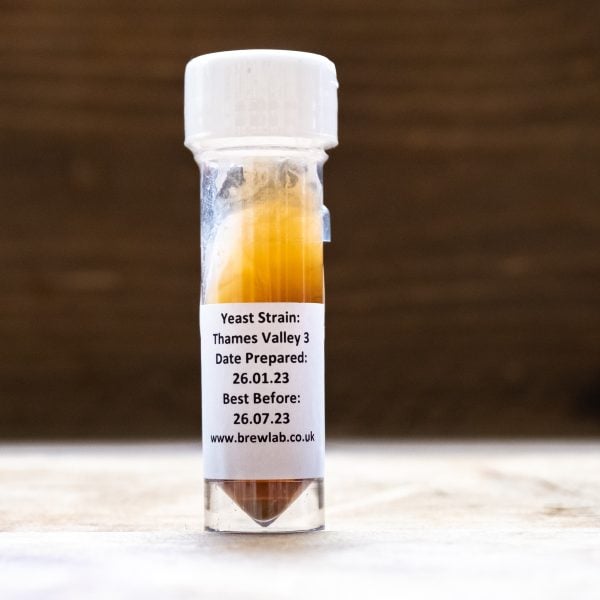
Description
Ferment your home brewed beer like a professional using a Brewlab Yeast Slope – exclusively prepared for The Malt Miller by all round yeast experts, Brewlab
Brewlab Yeast Slope have advantages over both dry and wet yeast for home brewers. Using fresh yeast, made from a Brewlab slope, will lead to a quick start and healthy fermentation. Each slope is freshly prepared for The Malt Miller and is supplied with a certified screen for contamination and Diastaticus. Use our simple instructions to grow the yeast cells to the required pitching rate.
Yeast cultures supplied by Brewlab are held on agar slopes to preserve their viability and consistency. They are stable for up to 6 months if kept in a refrigerator below 4C. Don’t freeze as this will spoil their viability.
Little equipment is required to prepare a yeast slope, a glass jar is sufficient. Remember, never grow yeast in a sealed vessel as the CO2 produced will cause a pressure build up. Check out our yeast slope preparation bundle here
Brewlab Thames Valley 3 Ale Yeast Profile:-
Single character. Standard bitter production. Slow fermentation speed. High mineral worts preferred. Moderate ester ability. Strong flocculation.
This London ale yeast has slow but steady fermentation abilities, prefers a strong mineral wort and produces a low to moderate ester flavoured beer. Very low sulphur is produced under stress and phenolic off flavours are not produced. It flocculates strongly producing a light head initially while cells sediment rapidly at the end of fermentation forming a strong sediment.

Martin Crossley (verified owner) –
Easy to use: great alternative to liquid yeast.
I’ve been meaning to try these for a while, but having yet another “dead” smack pack of liquid yeast on a recent brew-day finally pushed me to do it.
On first inspection it didn’t really look as if there was any yeast on the the surface of the growth medium in the tube, but as instructed I boiled up 3tbs of spraymalt in 300ml of water in a conical flask, cooled it right down and then transferred a teaspoonful into the yeast slope (I used a sterilised pipette but in fairness I could have just poured a bit in). Gave it a good shake and then poured it rather hopefully back into the rest of the wort in the flask. You’re not looking to dissolve any of the growth medium, just to dislodge the yeast colonies on the surface.
Anyhow after 24h on the stir-plate I was initially a bit dubious anything had happened but when I turned off the motor I could see plenty of sediment had formed, and within an hour there was a decent amount of fine foam. Result! I’m sure it’d work equally well with an occasionally-shaken sterilised jamjar too (although it’d probably take 48hrs instead of 12).
I’m sure you could pitch this 300ml straight into a 21L brew, but I think I might scale it up to 1L just to be on the safe side 🙂